Thursday, February 16, 2023

A Luminous Lovely Lady

This beautiful hand-painted tile in its original elaborate antique frame is from the German company of Konigliche Porzellan-Manufaktur Berlin (KPM). In the 19th Century, KPM was renown for its painted plaques depicting historic scenes or replicating famous paintings. KPM plaques were typically presented in ornate frames and the unusual frame on this example is exceptional, giving the impression that the lissom lass is looking out of a window.


The plaque is after a painting entitled “Lisette” by the German artist Georg Hom (1838-1911); in fact, when this blogger carefully unscrewed the back of the frame to confirm that it held a tile and not a print, on the back of the porcelain plaque were the fragile remains of a paper label carrying the name “Lisette.” Hom was known for his genre pictures of pretty women, sometimes illuminated by candlelight.


All posted items are for sale at Next-to-New, but things can sell quickly!
 

Wednesday, February 15, 2023

Intricate Art from Africa

This elaborately beaded sash was created by the Yoruba people of Nigeria.  Originally, beaded objects were considered sacred and only could be worn by royalty and the priesthood. Such sashes traditionally reflected the owner's noble or spiritual position and would be worn during public ceremonies.  Creating these intricate beaded pieces requires great skill (and thousands of beads).  In modern Nigeria, Yoruba artisans hand craft these stunning sashes as a form of artistic expression and these sashes are sought after by collectors of African art.


Cowrie shells were also an indication of wealth.


In some places the canvas base is built up to create a three dimensional effect. Images of birds and lizards originally indicated divine powers.  For example, birds could represent a female force that protected the king and punished those who engaged in immoral acts. 


All posted items are for sale at Next-to-New, but things can sell quickly!

16096-43

Wednesday, December 14, 2022

Pinball Wizard

He's a pinball wizard
There has got to be a twist
A pinball wizard's
Got such a supple wrist

"Pinball Wizard,"  1969, Peter Townshend

You too could be a pinball wizard or put on your own production of the rock opera "Tommy" with this fun and funky "Future Spa" pinball machine by Bally Manufacturing Corporation. Created in 1979, Future Spa was the first pinball game by this company to use a continuous background sound.  


The unique recessed back-box lighting and prismatic diffuser behind the "Future Spa" logo sought to create a holographic effect. Bally's marketing declared that, "Future Spa will awaken your pinball senses." 


The Bally Manufacturing Corporation was founded in 1932, and quickly became a leading pinball maker. By the late 1930s, the company began to manufacture mechanical slot machines. During WWII, Bally turned to manufacturing munitions and airplane parts. Afterwards, the company continued to manufacture and innovate pinball machines and gambling devices, as well as designing and manufacturing vending machines. By the 1970s, Bally expanded into video games, including three of the most iconic, Space Invaders, Pac-Man, and Ms. Pac-Man. Bally also began acquiring casinos and other businesses and in 1988 sold its arcade game division.

All posted items are for sale at Next-to-New, but things can sell quickly!

15901-21

Wednesday, November 30, 2022

Extraordinary Seascape by an American Master

This vividly colored study of a seascape is a work by renown American impressionist painter Curt Walters. 


Walters is a plein-aire (outdoors) impressionist painter whose works features landscapes and city scenes from all over the world, but he is most famous for his depictions of the Grand Canyon. Born in New Mexico in 1950, Walters moved to Taos to work and study with several artists. Subsequently, Walters moved to Sedona, Arizona, close to the Grand Canyon, which features so prominently in his art. In fact, in 1997, "Art of the West" magazine declared Walters to be the “Greatest Living Grand Canyon Artist." Walters has used his artistic skills to help preserve this national treasure, donating his works to the Grand Canyon Trust for fundraisers.

However, Walters has also captured the beauty of other sites in North American such as the landscapes of Colorado, the Canadian Rockies, and the rugged California coast. His travels through Europe, Bali, and Jordan have also inspired paintings. His skilled brushwork and brilliant colors have won him numerous awards, including the Nona Jean Hulsey Buyer’s Choice Award in 1998, 2002, 2011, 2013, 2017 and 2019 and the Frederic Remington Award in 2004 and 2005. In 2011, "Southwest Art" magazine named Walters as one of the Forty Prominent People in the Western Art World. His works are found in public and private collections throughout the world, including the Gilcrease Museum (Tulsa, Oklahoma), Autry National Center of the American West (Los Angeles, California), Eiteljorg Museum of American Indians and Western Art (Indianapolis, Indiana), and Forbes Magazine Galleries (New York, New York).

Walters is also the subject of a 2018 documentary, "Painting the Air: The Life and Art of Curt Walters." 


Thursday, November 17, 2022

Screen Time

This antique screen is a lovely example of the Japanese art of Shibayama. Shibyama features an intricate inlay of a variety of carved materials, such as mother-of-pearl, bone, or coral, on a background, often of contrasting lacquer or wood. Instead of being flush with the background, the carved pieces are slightly raised, giving a three dimensional effect. This lovely and luxurious two panel screen features an elegant dressed woman and a little girl among flowering branches, birds, and butterflies. 


Most of the delicate and detailed inlay is carved from shimmering mother-of-pearl, with the figures' faces and hands sculpted from bone.


The shibayama panels are on dark lacquer, framed by red lacquer painted with a stylized floral design. The wooden top and bottom of each panel are intricately carved as well. The top edge features an adorable Japanese dormouse about to feast on some tempting fruit. 


The shibayama technique was developed in the late 1700s in the town of Shibayama. The technique was used on a wide variety of items, from tiny netsukes (carved toggles used to fasten a pouch or container to a kimono sash) to large room screens. The craft reached its peak during the Meiji era (1868-1912), during which Japan moved from an isolated feudal empire to a more modern, industrialized nation. This period saw a flourishing of Japanese art and crafts, as the government not only encouraged artisans, but actively promoted Japanese art for export, such as at the Paris World Exposition in 1867. 

All posted items are for sale at Next-to-New, but things can sell quickly!

15918-42


Friday, October 21, 2022

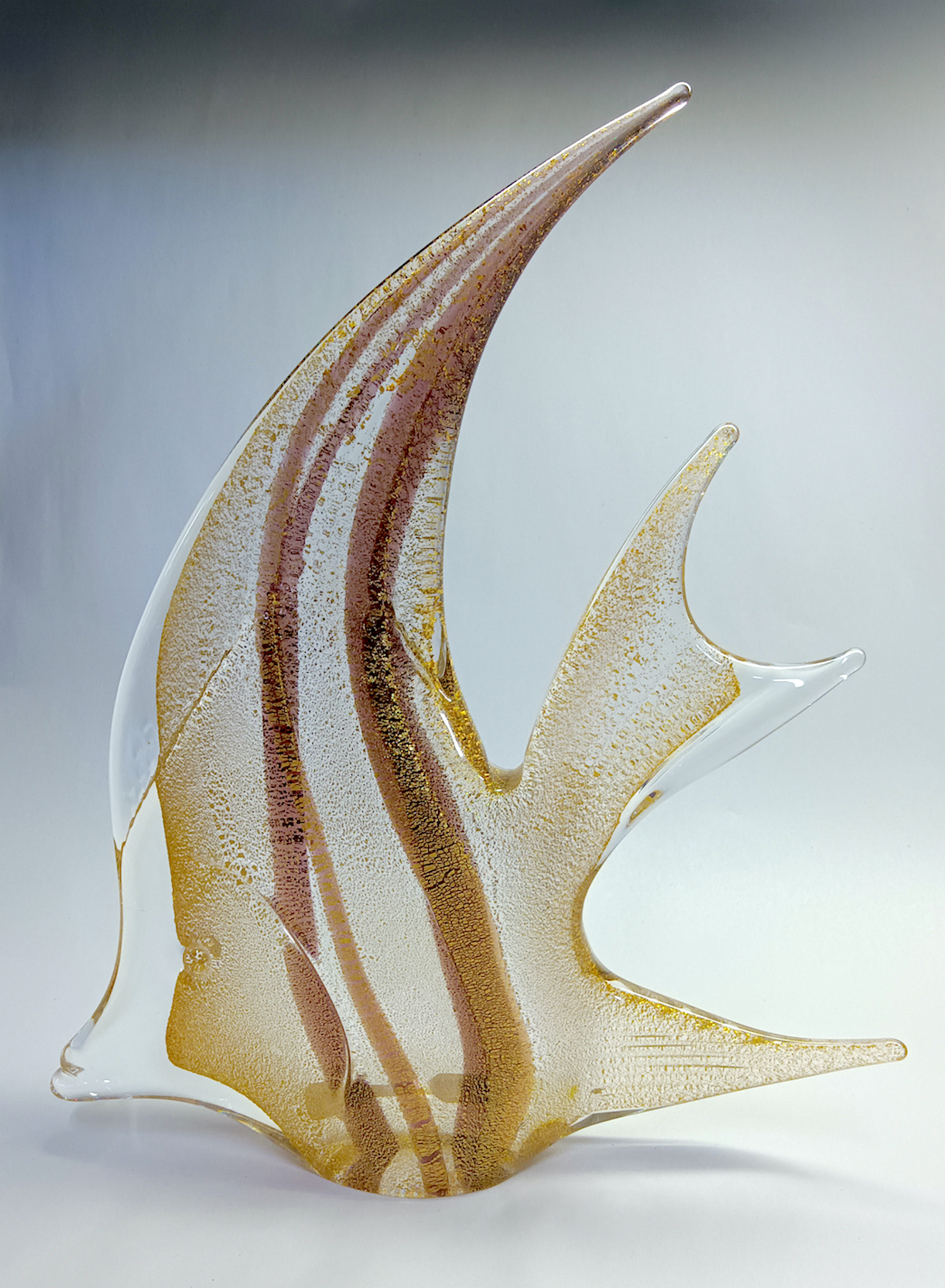
Shimmering Sea Life in Golden Glass

This graceful angelfish and appealing seahorse are crafted out of handblown glass accented with flakes of real gold. They are in the tradition of the world renown glass artistry of Murano in Italy, for, in fact, their creators first learned the craft of glassmaking on that famed Italian island.


These delightful denizens of the deep are the creations of the Marcolin brothers during their brief collaboration with Sardinia Crystal in Italy. Josef Marcolin was born in 1933 and his brother Benito Marcolin three years later.  Both studied glassmaking on Murano, moving to Sweden in the 1950s to work with various famous glassworks before starting their own company, FM Konstglas (Swedish for "art glass"). They focused on glass sculptures, combining traditional Murano glass techniques with the clean lines and minimalism associated with Scandinavian design. The factory closed in 1991, the brothers moving to Sardinia, Italy, with the intension of producing a similar lines with Sardinia Crystal. However, by the mid-1990s, Benito returned to Sweden and shortly afterwards Josef moved to Austria.

Both pieces are signed with the Marcolin name and Sardinia, was well as model numbers. 


All posted items are for sale at Next-to-New, but things can sell quickly!

3-6870, 3-6869


Thursday, September 22, 2022

Exhilarating Ertè

This stunning serigraph by Erté is part of his Numeral series in which men, women, and mystical creatures contort themselves to form the digits 0 through 9. 


In this vividly colored silk screen print, deeply embossed with golden accents, a woman and man, or perhaps a goddess and god, appear to dance against a galaxy of stars as they form the numeral "8."


Erté was born Roman Petrovich Tyrtov in Saint Petersburg, Russia, in 1892. His father, who was an admiral of the Russian Imperial Fleet and the director of the Naval Engineering School, wanted his son to become a naval officer as well, but Ertè was drawn to art and design. To escape the disapproval of his parents, he traveled to Paris in 1912 to pursue his dream of becoming a designer. It was there that he assumed the assumed the pseudonym "Erté," created from his initials "R" and "T." Erté began his career in the atelier of famed Parsian couturier Paul Poiret and soon was designing costumes for dance companies and performers, from the Ballets Russe to Mata Hari. Drawing from Orientalism, ancient art, and the burgeoning art deco movement, Ertè became renown for his use of rich, decadent colors and flowing fabrics. He also became an illustrator and his elegant exotic drawings appeared on the covers of "Harper's Bazaar, as well as in such publications as "Illustrated London News," "Cosmopolitan," and "Vogue." In 1925, Erté traveled to Hollywood to design movie costumes for the MGM Studios, including "La Bohème" (1926) and "Ben Hur" (1959). The art deco revival of the 1960s brought new attention to Erté's work and he began producing limited edition lithographs. Erté was enthralled by this new media, as it made his art more accessible to collectors. In 1974, Erté signed a contract with Circle Fine Art Corporporation to produce serigraphs, lithographs, and etchings of his earlier designs and illustrations. Well into his eighties Erté continued to create, branching out in bronze and fine jewelry. He died in 1990.
 

The piece is signed in pencil by the artist. . . 


and carries the original gallery label indicating that this piece is 42 out of a limited run of 350. The framed serigraph also comes with authentication paperwork.


All posted items are for sale at Next-to-New, but things can sell quickly!

12022-143