Sunday, November 22, 2020

Send in the Clowns

This is drawing on linen is by famed actor and comedian Richard Red Skelton (July 18, 1913 – September 17, 1997). Skelton began performing at the age of 10 in a traveling medicine show and over an entertainment career of some 70 years, Skelton was featured on stage, screen, and radio. He is probably best known for his variety television show, The Red Skelton Show, which premiered in 1951. The following year Skelton introduced one of his most beloved and recognized characters, "Freddie the Freeloader," an easy-going and gentle hobo clown. In the 1940s, Skelton had begun sketching and painting clowns as a hobby, but it did not publicly exhibit his artwork until 1964, when his wife persuaded him to display his art at the Las Vegas Sands Hotel, where he was performing. The exhibit was a success and Skelton began selling his original works, as well as prints and lithographs. 

However, this is no mere print, but an original one-of-a-kind artwork by Skelton. It is also beautifully framed.


The sketch is signed by Skelton and dated 1982.


As an added bonus there is a signed personal note from Skelton on the back with a small drawing of another clown.


It is said that Skelton loved clowns because he felt that they brought needed joy and laughter into the world. This charming and cheerful original artwork certainly should bring joy to its next lucky owner.

All posted items are for sale, but things can sell quickly!

15396-52


Tuesday, November 17, 2020

Authentic Alvar

This lusciously-colored lithograph is by Spanish artist Sunol Alvar, considered one of the last living Modernists. Alvar is a master of many artistic mediums, including painting, lithography, and sculpture. 


Born in 1935 in a Catalan fishing village on the outskirts of Barcelona, Spain, he attended the Sant Jordi Art School in Barcelona at age 16.  Two years later, Alvar was awarded a summer scholarship that allowed him to travel and paint throughout Spain. He returned home to compete in the Young Painter’s Prize sponsored by the City of Barcelona.  His painting won the Grand Prize and was acquired by the Museum of Modern Art in Barcelona for its permanent collection.

Beginning in 1957, Alvar began to exhibit his works with great acclaim and success. After winning the Grand Prize in the annual painting competition at the French Institute of Barcelona, Alvar traveled to Paris in 1959 to study and paint. He briefly returned to Barcelona in 1960 to marry his childhood sweetheart, but couple then moved back to Paris. Alvar produced his first lithographs in 1963 and would focus on this medium through 1990. In 1970, he and his family moved back to Spain. At the age of 70, Alvar returned to painting.  He has been commissioned to design a number of public art installations, including a mural in a suburb of Barcelona and a sculpture of cellist Pablo Casals in Paris. Alvar has been exhibited throughout the world and his works are in the collections of over 40 museums.   

The lithograph is both signed and numbered.


All posted items are for sale at Next-to-New, but things can sell quickly!
4061-518

Monday, November 9, 2020

Purple Majesty

This majestic set of mid-century modern pottery is a very rare example of "Purple Raisin" dinnerware by Vernon Kilns. The California company created this ultra-modern shape known as "San Marino" in the early 1950s, with sleek futuristic curves. A deep eggplant background contrasts with a rich purple drip glaze. This pattern was introduced in 1950 and was also available in brown, yellow and green. It  was only produced for three years and afterwards was available only by special order, Vernon Kilns ceased operation in 1958. We have many unusual and scare dinner and serving pieces in this striking stoneware set. The luxurious color and retro design will enhance any table.


 All posted items are for sale at Next-to-New, but things can sell quickly!

Sunday, November 1, 2020

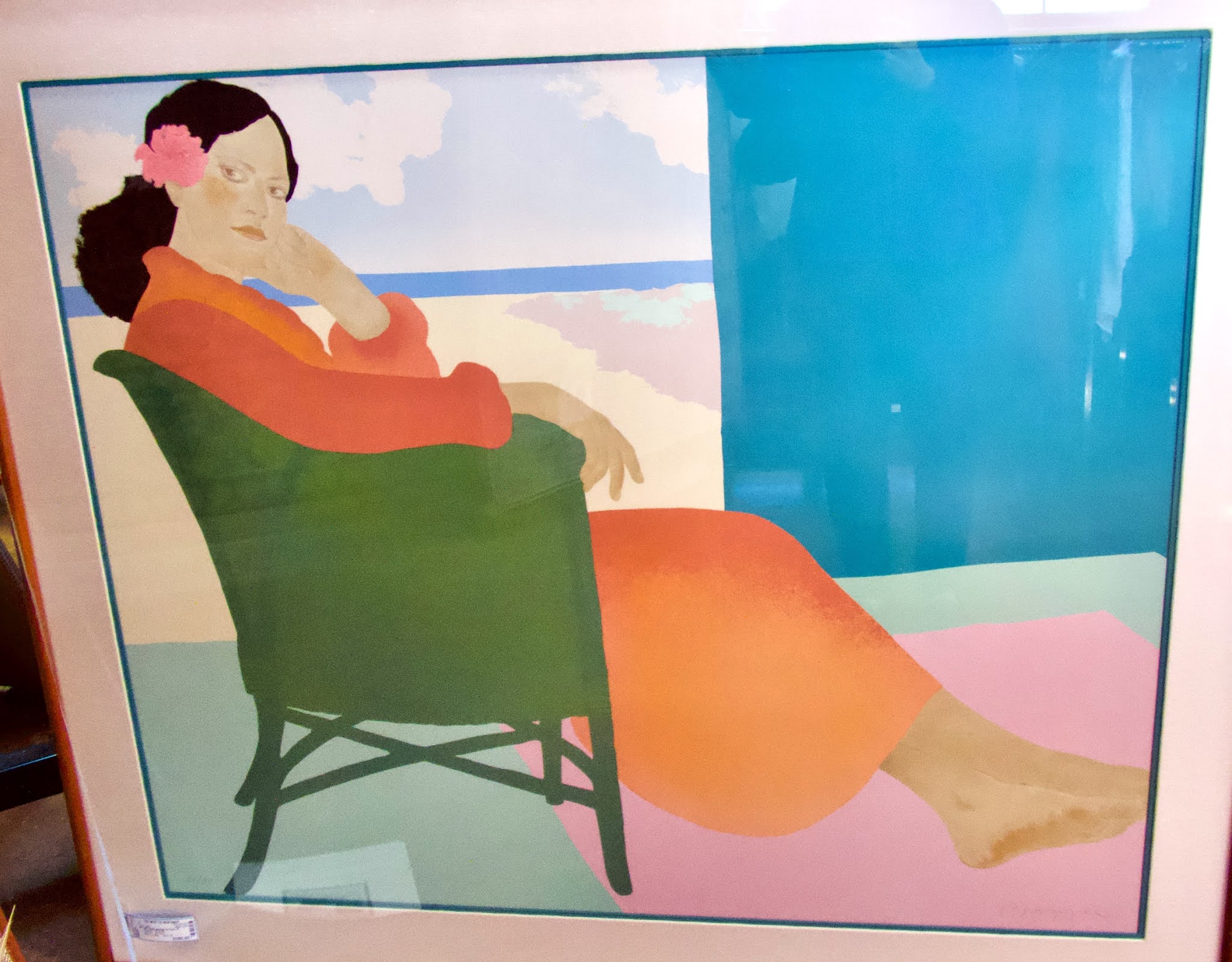
Aloha from Hawaii

This limited edition serigraph is as large as it is lovely (the image alone is image size 33 inches by 40 inches). By Pegge Hopper, it is entitled "Lanikai Afternoon"and was issued in a limited edition of 300 in 1984. Unfortunately, these photographs do not do justice to Hopper's vibrant colors, assured lines, or compelling subject. 


Although Hopper was born in Oakland, California in 1936, she is best known for her distinctive studies of beautiful and strong Hawaiian women. Hopper graduated from the Art Center College of Design in Pasadena, California. Before moving to Hawaii in 1963, Hopper designed murals and posters in the United States and Europe. While working as an art director in Hawaii, she came across vintage photographs of Hawaiian women at the state archives. Hopper was impressed by how confident and self-actualized the women were, "not trying to be beautiful, not trying to be skinny, not trying to look any way. Just there, in all their glory.” In 1970, Hopper began to create her own images of Hawaiian women and in 1983 opened her own gallery. She has done many one-women shows both in Hawaii and the continental United States and her art is featured in the permanent collections of the Hawaii State Foundation on Culture and the Arts, The Contemporary Arts Center in Hawaii, the Bishop Museum in Honolulu, the Honolulu International Airport, and the Pacific Club, as well as in many private collections

This print is numbered in pencil "104/300" and is signed by Hopper.


All posted items are for sale at Next-to-New, but things can sell quickly!
4061-525


Sunday, October 25, 2020

Southwestern Spirits

These unusual and beautiful limited edition lithographs depict traditional Hope Kachina dancers.  The Hopi people believe that Kachinas are personifications of the natural and spiritual worlds. A Kachina can represent plants such as beans or corn, living creatures, natural phenomena such as rain or wind, heavenly bodies, revered ancestors, or other physical or spiritual concepts. They are the links between mortal people and the spiritual world and must be treated with veneration. In return, the Kachinas can aid humans, such as bringing rain for the crops or ensuring a bountiful harvest. In ceremonial observances, men dress as Kachinas; each Kachina can be identified by its signature mask and costume. Kachina dolls or figurines were originally carved by Hopi artisans and during the ceremonial dances given to children to teach them about the different Kachinas, although many are now created for collectors and the tourist trade.

In 1904, artist and sculptor Joseph J. Mora (1876-1947) lived among the Hopi and Navajo tribes in Arizona and New Mexico, learning their languages and using his artistic skills to document their rituals. This included a series of detailed watercolors depicting Hopi men dressed as Kachina dancers.  In the mid-1990s, John Wilson purchased 40 of Mora's watercolors and planned to issue limited edition lithographs of the paintings. However, due to financial constraints, only eight lithographs were issued in limited editions of 650 each.

These are two of the lithographs issued by Wilson, both marked in pencil "126/650." This one represents She-Eu-Heu-Mish, also known as Sio Hemis, identified by his colorful tableta or headdress decorated with stylized dragonflies and sunflower. This Kachina takes part in the Niman Ceremony. It is also known as the Home or Going Home Dance and signals the end of the Kachina season. He is considered an important rain spirit. 


This lithograph depicts another Kachina who appears in the Niman Ceremony, Heu-Mish-Kachina-Mana, or the Hemis Maiden. Her hairstyle is that worn by unmarried Hopi women. She is a music maker, using a notched stick and hollow gourd to provide rhythmic accompaniment to the dancers.


All posted items are for sale at Next-to-New, but things can sell quickly!
4061-522
4061-523

Monday, October 5, 2020

Band of Brothers

This scarce and unusual poster is a piece of Texas history in several ways. First, it features the Callahan Brothers. Although born in Laurel, North Carolina, (Walter in 1910, and Homer in 1912), they gained famed as cowboy music and western musicians in Texas. They first began performing in the bluegrass and hillbilly genres in the 1920s. In 1941, the brothers moved to Dallas, Texas. Influenced by "singing cowboys" such as Roy Rogers and Gene Autry, the brothers not only adopted a more western sound, but new names as well, Walter becoming Joe and Homer rechristening himself as Bill. They gained fame on Big D Jamboree, a Dallas-based barn dance radio program, and recorded with Decca and Columbia Records. In 1945, the brothers went to Hollywood to record songs as part of the soundtrack for the movie "Springtime in Texas" However, by 1951, they stopped recording together and Walter returned to North Carolina. Homer remained in Dallas and became a photographer.


The poster further commemorates KWFT, the radio station featuring the brothers.  KWFT signed on in Wichita Falls, Texas, in 1939 on 620 kilocycles. It was the first radio station to continuously operate in the city. In 1953 it also entered the new medium of television as  KWFT-TV Channel 6, but sold the television station in 1956. KWFT's last broadcast was on December 24, 1994.


Finally, the poster is also a memento of  Texas manufacturing as well as music history. The sponsor was the brothers' radio show was "the makers of Wichita Overalls." Wichita Brand Overalls were manufactured by the Great Western Garment Company in Wichita Falls. In the late 1800s and early 1900s, there was a movement to establish factories in the south to process raw cotton and manufacture cotton fabric closer to the source. Garment manufacturers in Wichita Falls included Tuf-Nut Manufacturing Company, which was established in 1928, and Levi-Strauss. However, many of these American fabric mills would later close or move their factories overseas.


All posted items are for sale at Next-to-New, but things can sell quickly!
10380-1122
 

Saturday, September 19, 2020

Ode on a Grecian Urn

Well, actually, two urns. . . and not Greek, but Italian.  However, this substantial set of superbly sculpted solid bronze urns are certainly worthy of an ode.


They are each signed on the lip "Alimondo Ciampi" and "Firenze" (the Italian name for Florence). Ciampi (1876-1939) was an Italian sculptor. He began as an apprentice in a Florence a marble and alabaster workshop, where he learned how to carve stone, then studied in the studio of the sculptor Antonio Bortone. Ciampi became a teacher at the Academy of Fine Arts in Florence. His works were exhibited at the Venice Biennale from 1909 to 1924, as well as in many other exhibitions. In 1926, his  war memorial was unveiled in the Piazza Matteotti in Scandicci.  A permanent exhibit of eight of his bronze sculptures is in the gardens of Piazza della Repubblic in Signa.  Ciampi's oldest son, Giotto Ciampi, created the Alimondo Ciampi Foundation in memory of his father to assist and support young artists.


The handles are adorned with young children or cherubs, demonstrating Ciampi's skill in capturing gesture and movement.


All posted items are for sale at Next-to-New, but things can sell quickly!
12194-41