Showing posts with label Mexico. Show all posts

Thursday, December 26, 2024

Bullseye!

This stunning sterling silver necklace features an unusual design of a flight of arrows converging in the center of a target. 


Beautifully crafted and constructed, this substantial necklace curves comfortably around your neck.   

The necklace is stamped on the back of the pendant both "Sterling" and "925," the assay mark for sterling silver, guaranteeing that the metal is 92.5 percent silver. As indicated by the incised "Hecho in Mexico," this unique piece comes from our neighbor to the south; it is also marked "Taxco GRO." "GRO" stands for the Mexican state of Guerrero and Taxco is a city there renown for its fine quality silver and skilled silversmiths. Taxco has long history of silver mining, dating back to pre-Columbian times. Hernan Cortes later claimed Taxco's silver for Spain, and himself, but as the silver veins ran out and other richer mines were located, the mines were closed. In 1716, Spaniard Don Jose de la Borda discovered another rich vein of silver in Taxco and mining began anew. However, during the Mexican War for Independence, the Spanish mine owners destroyed the mines and fled. 

A new chapter in Taxco's silver history opened with the arrival of American William Spratling in the late 1920s. Spartling, an architect, settled in Taxco, attracted by the beauty of the quiet and isolated city. Although he originally settled in Taxco to pursue a writing career, he soon found himself intrigued by Mexican art and crafts. Spratling learned the art of silversmithing and built a workshop hiring local craftspeople to create his designs, often inspired by Aztec and Mayan art. He also started an apprenticeship program to train silversmiths and soon many of his protégés were opening their own workshops. The completion of a highway opened Taxco to tourists and when WWII interrupted the European jewelry industry, high-end American department and jewelry stores began to feature Mexican gold and silver jewelry. The Mexican aesthetic also fit well with the sl]eek lines of the mid-century modern movement.

Although its silver mines have long been closed, Taxco remains a center for silver, with hundreds of workshops creating sterling jewelry and decorative pieces. This vintage piece is signed "Beto." In the first early part of the 20th century, Mexican silver items were marked typically marked "silver" or "sterling," with an assay number indicating the finess of the metal, and often, in addition to "Mexico or "Hecho en Mexico," with the name of the town, as well as the maker.  In 1948 the Mexican government introduced an eagle mark, but it was replaced in the 1980s with a number and letter system, beginning with a letter identifying the location of manufacture (such as "T" for Taxco), as second letter of the silversmith's first or last name, followed by the registration number of the maker.


All posted items are for sale at Next-to-New, but things can sell quickly!

1677-1494


Thursday, June 23, 2022

Superb Pitcher

Summer is the time to enjoy a tall cold glass of iced tea or lemonade and this stunning sterling pitcher is just the the thing for serving your guests such refreshing libations.


Underneath, it is stamped "Sterling 925," but its hand-hammered design gives a clue to this shimmering silver pitcher's origin. . . .


The shoulder of the pitcher is adorned with in high relief with stylized flowers. Known as "Aztec rose," this pattern appears widely on vintage Mexican sterling, from flatware and serving pieces to jewelry. The roses are rendered in repoussé, meaning that they were shaped by hammering from the reverse side. The skilled silversmith then added further detail by engraving or stamping lines in the leaves and petals.


All posted items are for sale at Next-to-New, but things can sell quickly!

15735-242


Friday, December 17, 2021

Powerful Portrait

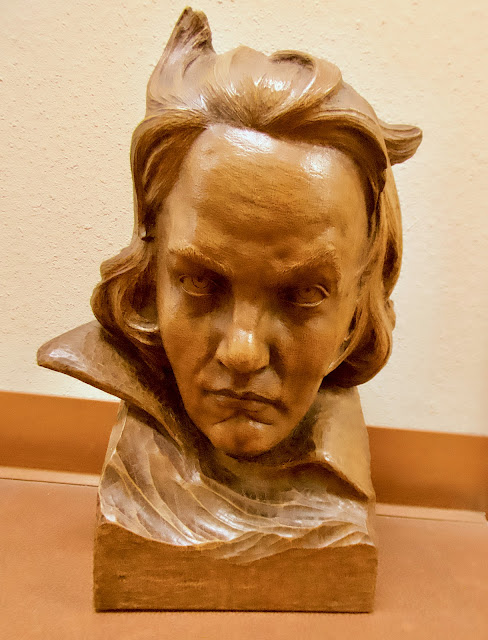
Carved from rich wood, this superb portrait is by Mexican artist Fidias Elizondo (1891-1879). Considered one of the finest sculptors in Mexico, Elizondo was a major influence in Mexican and Latin American art, mentoring many younger artists. Born in Monterrey, at the age of 17 Elizondo followed his dream of becoming at artist by traveling to Mexico City to study at the Academia de San Carlos. At the urging of one of his professors, in 1913 Elizondo traveled to Europe to study, arriving in Paris at the start of WWI. Although he spent much of his time working in the war effort to defend the city, it was in Paris that he created some of his first wood sculptures. After living in Barcelona and Argentina, Elizondo returned to Mexico in 1921. He was a professor at the Escuela de Pintura al Aire Libre and the Academia de San Carlos. Elizondo's most famous work is the monumental statue of Cristo Rey atop the Cubilete mountain in Guanajuato.


The sculpture skillfully portrays a man with tousled hair and an intense expression. The bust resembles a bronze portrait Elizondo created of Beethoven.


It is signed by Elizondo and dated 1936.

A note taped underneath carries some information, although it misspells Elizondo's first name and places his birth date at 1902.


All posted items are for sale at Next-to-New but things can sell quickly.


Sunday, December 22, 2019

Pretty Kitty!

This big bold vintage brooch is signed by the renown Mexican jewelry designer, Margot von Voorhies Carr, also known as Margot of Taxco.   Of shining sterling silver, with glowing amethyst eyes, this fantastic feline is a purr-fect example of Margot's creative and eye-catching designs. Her jewelry is highly sought after by collectors.   Born in the United States, Margot arrived in Mexico in 1937, where she met and married Antonio Castillo.  They settled in Taxco, a center for the production of sterling silver jewelry, flatware, and objects.  There Castillo opened Los Castillo Taller, where Margot worked as the atelier's principal designer.  After the couple divorced, in 1948 Margot set up her own taller (workshop).  Her pieces incorporated designs inspired by pre-Columbian artifacts and Mexican art.  However, following a fire in 1960 that forced her to move her studio, Margot began to suffer financial difficulties, closing her workshop in 1978. 


On the back, the brooch is clearly stamped "Margot de Taxco." The eagle stamp was issued by the Mexican government and identifies either the city of assay or the manufacturer. In the piece, the eagle carries the number "16" on its chest, the assay number registered to Margot. Other marks are "Sterling," and "5220," with is the production number.


All posted items are for sale at Next-to-New, but things can sell quickly!
15145-49

Sunday, October 13, 2019

Roses in Repoussé

This superb sterling silver compote is from the Maciel Silver Factory, which was based in Mexico City from 1930 through 1970.  The company was renown for its high quality hand hammered sterling  tableware, flatware, and jewelry. 


The floral pattern is known as Aztec rose.  The roses are in repoussé, meaning that they were hammered into relief from the reverse side.


Underneath the compote carries the Marciel mark.


All posted items are for sale at Next-to-New, but things can sell quickly!
15008-56