Wednesday, February 19, 2020

These Spoons will Cause a Stir!


Inside this reddish-brown box from our trove of treasures. . . 


. . . is a set of six extraordinary antique demitasse spoons, nestled on yellow satin.  What sets these spoons apart from your typical tableware is that each is topped with twin teeth!


During the Victorian period, there was a fashion for ornaments incorporating animal parts.  Inspired by the Raj, tiger claws and teeth became earrings and pendants, pins made of grouse claws were a popular souvenir of Scotland, and the canine teeth of deer and elk could be found in a wide variety of gold and silver items.  In Austria and Germany, it was a tradition to set deer teeth, typically the trophies of a successful hunt, into jewelry.  Called "hirschgrandln," the tooth-trimmed jewelry was considered good luck, especially for future hunts.  Prince Albert brought this tradition from his homeland, in 1860 giving his beloved Queen Victoria an ornate gold and enamel necklace adorned with the teeth of 44 stags hunted by Albert at the royal estate Balmoral in Scotland. Each tooth was inscribed with the date each animal was killed.  Hirschgrandln became a popular souvenir for Alpine visitors, with a wide variety of pieces being made to satisfy the tourist trade.  The finely detailed oak leaf motif on the top of each handle is very typical of hirschgrandln.


The spoons are marked "800," indicating that they are 80 percent silver.  In 1884, 800 was made the national minimum silver standard in Germany.


All posted items are for sale at Next-to-New, but things can sell quickly!
6881-164


Tuesday, February 11, 2020

How Ladylike!

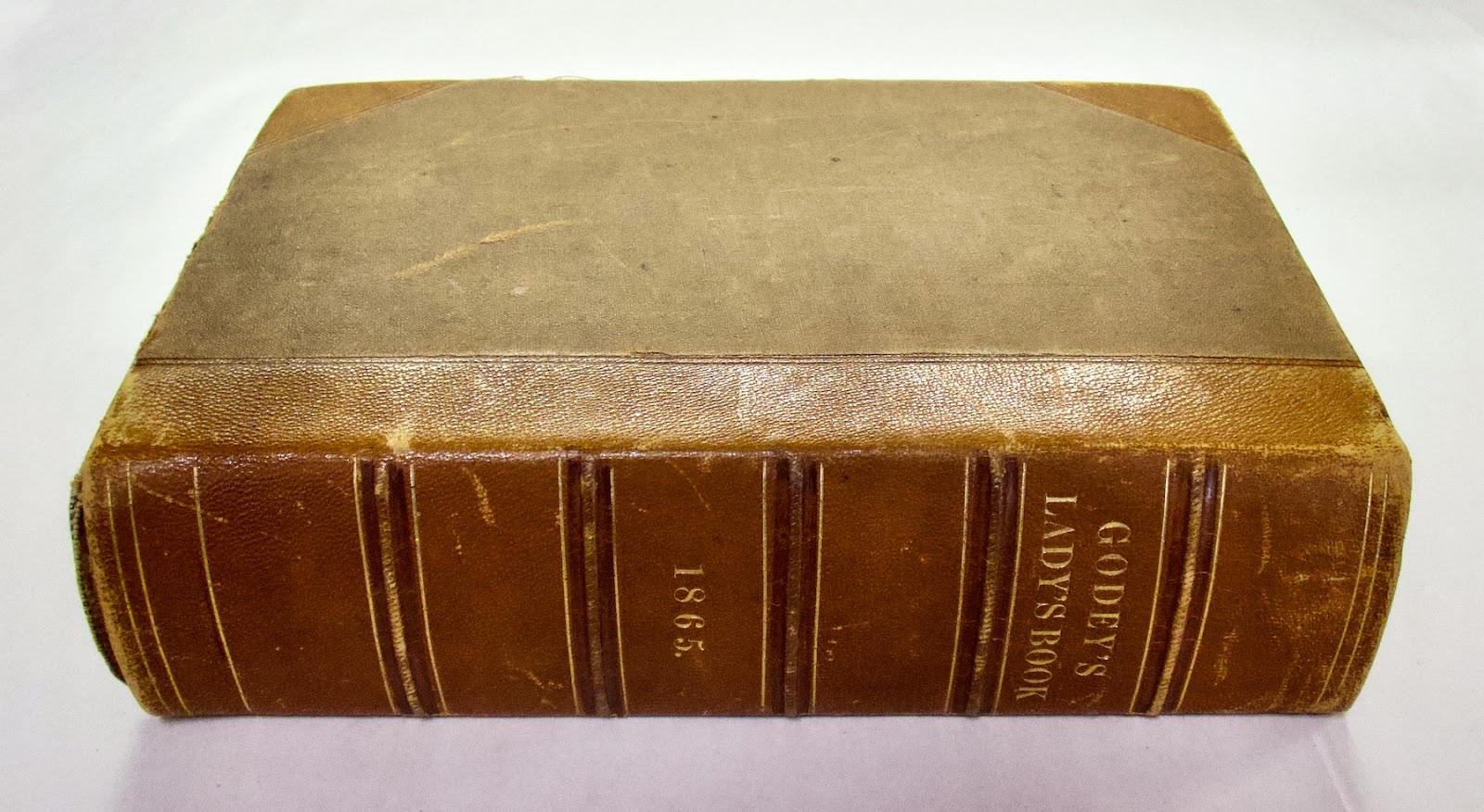
Godey's Lady's Book, founded by Louis A. Godey, was an American monthly magazine published from 1830 to 1878. Next-to-New's treasure trove contains this handsome leather-bound volume for 1865.


Each edition included stories, poetry, music, articles, and illustrations, many from prominent writers and artists of the period. Prior to the Civil War, it was the most widely circulated magazine in the United States.


It addition to its literary offerings, the magazine included patterns and instructions for embroidery, sewing, and other handicrafts.


However, perhaps its most striking feature was that every edition included "La Belle Assemble," a beautifully detailed and hand-colored fold-out fashion plate showing elegant ladies and pretty children adorned in the last fashions.  


If you are a fashion historian or a simply lover of history, this beautiful volume deserves a prominent place in your library.

All posted items are for sale at Next-to-New, but things can sell quickly!
15145-189


Monday, January 27, 2020

Glorious Gucci Necklace

This simple yet exquisite cross necklace is from the famed Italian fashion house of Gucci.  The cross is of rich dark wood, trimmed in sliver, hanging from a substantial sterling chain.


In addition to the Gucci hang tag, the clasp is also marked with the company's name, as well as "Ag 925," the assay mark for sterling silver, meaning that the metal is 92.5 percent pure silver.


One of the best known high-end fashion houses in the world, Gucci was founded in 1921 by Guccio Gucci. While working in hotels in Paris and London, Gucci studied the high-quality luggage used by the hotels' patrons. Upon returning his native Florence, Gucci established a shop offering finely made and classically designed leather luggage and handbags created in his atelier. With the help of his three sons, Gucci added shops in Milan and Rome and expanded the inventory to include footwear, silks, and knitwear. By the 1950s, Gucci had stores worldwide. Wealthy jet-setters and movie stars flaunted Gucci's iconic leather goods and clothing, making Gucci an international status symbol. In fact, "Gucci" has become an adjective to indicate that something is expensive and high-quality (on the other hand, the term "Gucci gulch" describes the cluster of highly-paid lobbyists waiting outside of a legislative hearing room). Later Gucci added jewelry, watches, and eyewear to its growing fashion lines. It is highest-selling Italian brand and is considered one of the most recognizable and valuable brands worldwide.

All posted items are for sale at Next-to-New, but things can sell quickly!

15062-45


Friday, January 17, 2020

Captivating Conchos

This beautiful belt is stamped from sterling silver, studded with sky-blue turquoise stones.  It is by renown Navajo silversmith Marcella James.


The oval pieces are referred to as conchos.  The word derives from the Spanish "concha," which refers to a conch or seashell.  Conchos were used by the Spanish to adorn saddles and bridles, as well on clothing and as jewelry.   Concho belts have become a tradition among the Navajo Indians, who began making conchos around the 1860s, at first hammering them out of silver coins.  Originally, the conchos were strung on leather woven through center slots in each piece, but later Navajo silversmiths began to solder loops on the back for a belt to slide through, allowing the center of the concho to decorated.  There are two basic types of concho belts, with either the conchos strung on leather or connected by links.  A link concho belt can be fastened with a hook almost anywhere on the belt, so that it can be adjusted to fit many waist sizes.  This breathtaking belt could accessorize any outfit, from casual denim to elegant evening wear.


Often the conchos alternate with decorative spacers.  The most traditional form is called a butterfly, and looking at the spacers on this belt, it is easy to see why.


The belt is signed by Marcella James and is marked "Sterling."

Friday, January 10, 2020

A Gorgeous Guidotti

Next-to-New is proud to present this big and brilliant painting by listed artist Giovanni Guidotti. Born in Rome in 1917, he studied at Liceo Artistico of Rome. Guidotti is known for his impressive impressionistic landscapes and market scenes, rendered bold strokes and bright colors. 


This is his rendering of a bustling market in Haiti on a luminous sunlit day.


All posted items are for sale at Next-to-New, but things can sell quickly!

15168-217

Saturday, January 4, 2020

Retro and Riveting Roseville Pottery


One of America's best beloved art potteries, the world renown Roseville Pottery was founded in 1890 in Roseville, Ohio. It first produced utilitarian household stoneware, such as flower pots. In 1900, Roseville introduced its first art pottery line called Rozane.  Over the years, Roseville created a series of art pottery lines reflecting a number of influences, such as art deco, modernist, and nature, using a variety of colors and glazes.  Once one of the largest pottery companies in the United States, the company closed its doors  in 1954.

Next-to-New currently has a small but select collection of this desirable collectible art pottery.  The clean streamlined lines and subtle coloring of Roseville Pottery fit into any decor.


All posted items are for sale at Next-to-New, but things can sell quickly!

15181-3, 15181-2, 15181-13


Wednesday, December 25, 2019

Ring in the New Year!

If you want to start the coming year with a big bold gesture, this large and lovely antique ring is just the accessory you need.  Handcrafted in gold with a gleaming oval black onyx stone, this ring sits in its original green velvet box from Carl Mayer.  


As is often typical of artisan antique jewelry, the metal does not carry an assay mark.


Born in Prussia, Carl Mayer opened a jewelry store in 1865 at 618 Congress Street in Austin. He died in 1916 and is buried at Austin's historic Oakwood Cemetery. Carl Mayer Jewelers was a fixture in Austin for many decades. In the book, Lady Bird Johnson; An Oral History, the former first lady reminisces about how she and Lyndon Johnson selected her engagement ring and wedding band at the Carl Mayer store.


It is possible, considering the age of the ring and its style, that it is a piece of Victorian mourning jewelry.  During the Victorian period, strict rules regarding the etiquette of mourning the loss of a loved one were developed, partly influenced by Queen Victorian, who wore mourning for the rest of her life after the death of her beloved Prince Albert in 1861. The etiquette set wide variety of rules regarding behavior, including what one should wear and how long a person should properly mourn. Failure to comply would not only be seen as dishonoring the dead but also would reflect adversely on the violator's moral character. For example, a woman was expected to be in deep mourning for two years after her husband’s death, wearing only black garments and accessories. Mourning etiquette applied to jewelry as well. Victorian mourning jewelry used somber, dark-colored materials, such as jet, or, in this example, deep black onyx.

All posted items are for sale at Next-to-New, but things can sell quickly!
6881-172