Friday, September 6, 2024

Gig 'Em!

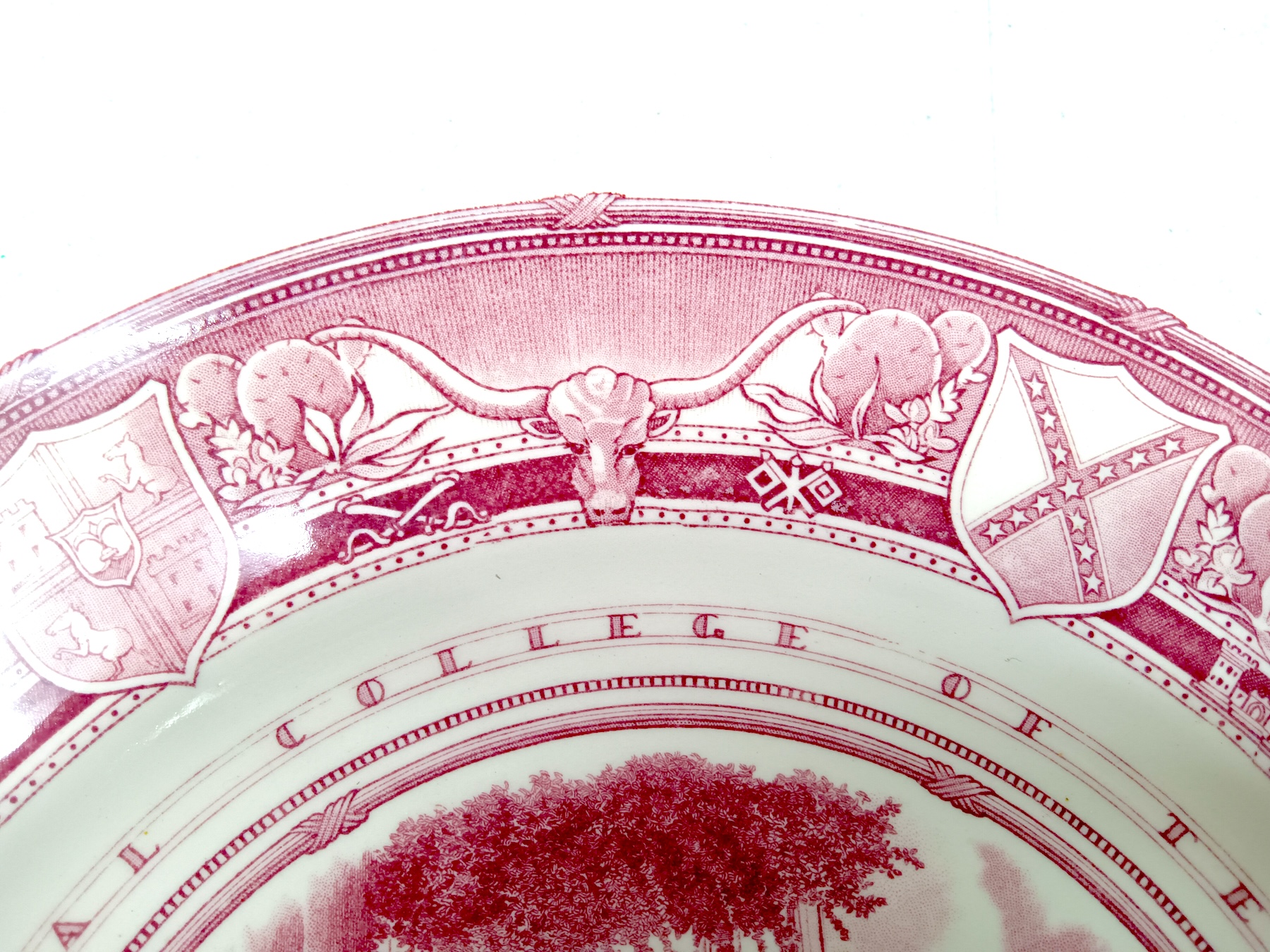
Previously on this blog we featured a rare 1937 Wedgwood commemorative plate featuring one of the buildings at the University of Texas at Austin campus. Now, from our trove, we present this vintage Wedgwood plate honoring UT's arch rival, the Agricultural and Mechanical College of Texas, better known as A&M. Appropriately colored maroon and white, the plate features the Academic Building, completed in 1912.


This plate was one of a 12-piece set of dinnerware depicting various landmarks of the A&M campus. Pinky L. Downs, a member of the A&M Board of Regents from 1923 to 1933, is credited with the idea of commissioning the plates (he is also said to have introduced the Aggie "Gig’em" hand sign). In 1935, the university held a contest between its landscape arts and architectural majors for the plates' design and the winner, Jack F. Doyle, was awarded $10 and a complete set of the original 12 Wedgwood plates. Two additional plates, featuring the All Faiths Chapel and the Memorial Student Center, were added in the 1950s.

The plate is stamped on the back with Wedgwood's mark and the mark of the importer. Most plates in this series also included a stamp on the back of an Aggie cadet standing at attention, but some, such as this one, are mysteriously missing this mark. 


The design around the rim depicts six shields, each representing one of the flags that flew over Texas, as well as prickly pear cactus, and, somewhat ironically,  longhorns.

All posted items are for sale at Next-to-New, but things can sell quickly!

Thursday, September 5, 2024

An Astounding Still Life

This amazing art work is by Texas artist Stephen Kirk Richards. 


Richards is renown for his meticulously detailed realist paintings and his use of deep rich colors.  His works include still lifes, landscapes, portraits, and historical or literary images. 


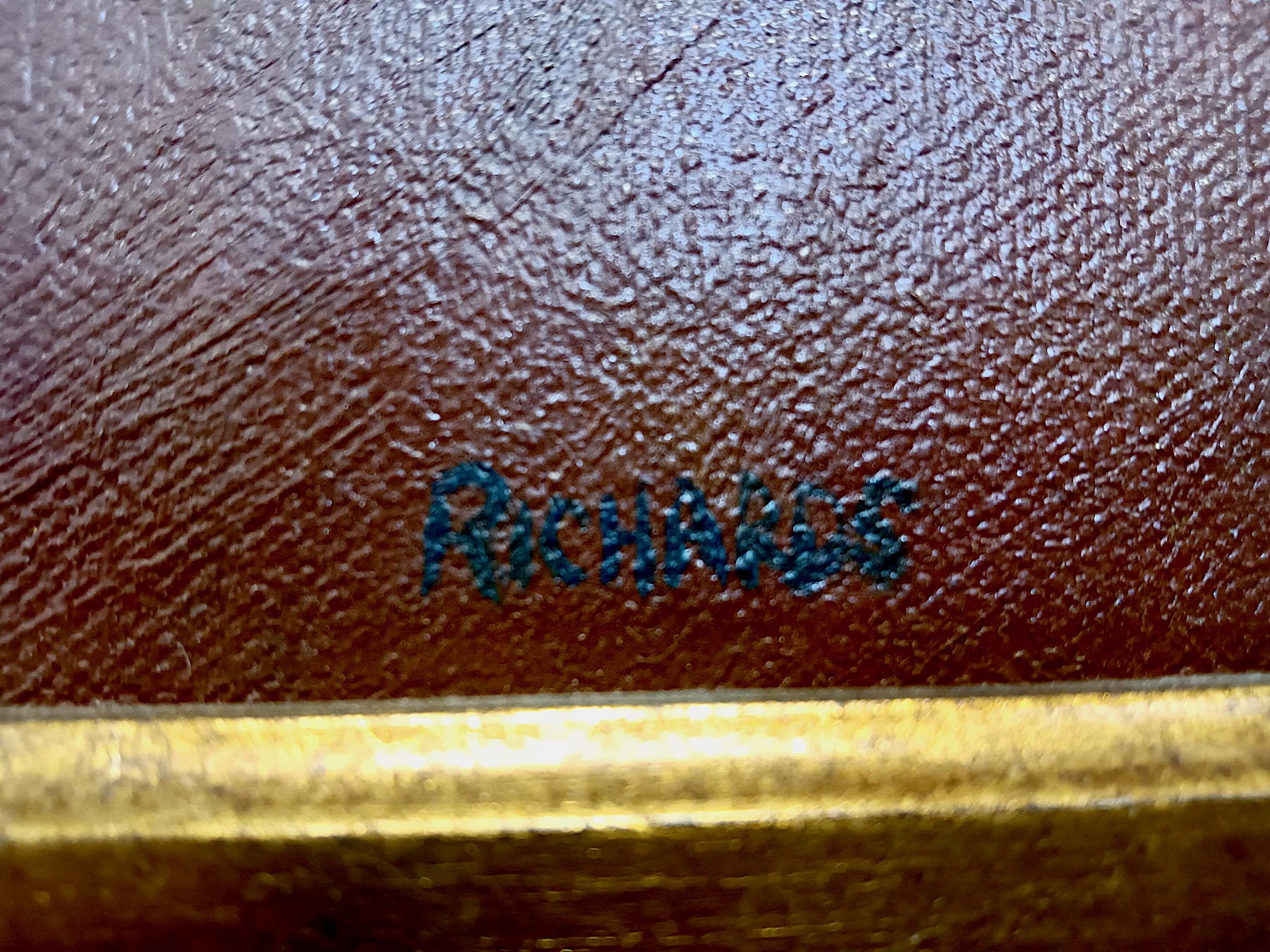
The painting not only carries Richard's signature, but also has a copy of his biography on the back. 


 Richards was born in 1952 and currently resides in Amarillo.  He earned his Bachelor of Fine Arts and Master of the Arts degrees at West Texas State University and studied with American painter Richard Lack.  He is one of the 24 artists in this country who is certified by the American Portrait Society and has exhibited throughout the country.  Richard's works have won numerous awards, including the: 1987 Lee M. Loeb Memorial Award for Excellence, 2011  Best of Show in the National Juried Biennial Exhibition at the Amarillo Museum of Art,  and the 2013 Goddess of Art Award in the first annual National Invitational Exhibition of the American Society of Traditional Artists in Scottsdale, Arizona.  He is an honorary member of the American Society of Traditional Artists and an honorary Living Master at the Art Renewal Center.  His works are included in many private and public collections and he has received numerous commissions.  

All posted items are for sale at Next-to-New, but things can sell quickly!

16152-157


Sunday, August 25, 2024

Two Heads are Better Than One. . .

. . . especially on this beautifully bizarre vintage bar or table featuring an exotic elephant who is literally two-faced.  From the American furniture firm of Hancock & Moore, this phenomenal pachyderm dates from the 1990s. 


The table top itself may be a replacement, but the original mounting hardware appears to be in place. The gilding also may be a previous owner's customization. However, this extraordinarily uncommon elephant table is a rare beast indeed and will appeal to any affictionado of the unique.


Hancock & Moore was founded in 1981 in North Carolina. Employing skilled craftspeople, the furniture is handmade and built to order, using high quality wood, upholstery, and leather. 

All posted items are for sale at Next-to-New, but things can sell quickly!

16151-1376


Wednesday, August 21, 2024

I'm For An. . .

 amphora as lovely as this one.

Although traditionalists might argue that an amphora is large double-handled vase used for storage in ancient Greece, to a collector of antique art nouveau, amphora instead refers to the delicate and detailed ceramic or terracotta art objects created in what was known as Bohemia from the late 1890s through the early 1900s. One company in this region marked its wares with the name "Amphora" and it has become a general descriptive term for the striking art nouveau vases, pitchers, ewers, bowls, and other decorative works from this era and area. This terracotta centerpiece bowl is indeed an amphora. 

Art nouveau was an artistic movement from the 1890s through 1910s that looked to nature for inspiration and is exemplified by undulating and sinuous lines, giving the feeling of movement. It was a reaction against staid academic art and the overdone and eclectic Victorian decor. Nubile nymphs, such as this luscious lass, barely clad in swirling robes and flowing tresses, were a frequent feature in art nouveau works. 

The piece is stamped "Stahlknetch" and with a model number. Waldemar Stahlknecht was a Germany factory specializing in terracotta and majolica during the amphora era.


All posted items are for sale at Next-to-New, but things can sell quickly!
16704-23


Wednesday, August 14, 2024

Extraordinary Epergne!

This glorious example of handblown glass is an epergne, an elaborate centerpiece that would beautify any banquet. The epergne first appeared in the early 1700s. Originally wrought of silver, the epergne featured a center basket or bowl from which radiated branches holding little bowls or baskets, all filled with fruit, sweets, and other treats. It is thought that epergne is derived from the French word "épargne" for "saving," perhaps because dinner guests could help themselves to a laden epergne situated on a sideboard, saving them the trouble of passing dishes. In the Victorian period, elaborate epergnes of brilliantly colored glass. like this stunning example, were used to display fragrant bouquets of fresh-cut flowers.


The rosy red glass is called "cranberry," a color especially favored by the Victorians. The rich red of cranberry glass, also known as gold ruby glass, is achieved by adding gold salts or colloidal gold to the molten glass. Because of the use of gold in its creation, cranberry glass was used primarily to create expensive glassware and ornaments. A piece as ornate as this epergne, with its extensive use of costly cranberry glass, served to display not only flowers, but also its owner's taste and class.


All posted items are for sale at Next-to-New, but things can sell quickly!

6179-936


Friday, August 2, 2024

Flower Power!

This treasure from our trove is a real blast from the past, a desk and dresser from the Drexel "Whimsy" line, introduced in 1969.


The flower-child inspired design features blossoms in bright yellows, red, and white against an orange background. Groovy!


Even the handles feature flowers.


Working at this delightful desk could almost make homework or paying bills fun. . . .


Each piece is stamped on the back "Whimsy - By - Drexel."


An advertisement from the time shows a bright bedroom decked out in this wonderful whimsical style. It assures the "Free Spirit" who wants her "Citadel" to "say something" with "zap" that this "flower-powered" furniture has a finish that will keep it as fresh as a daisy. The posy pun-filled ad promises that the furniture doesn't cost a "bunch" and invites customers to come see the "whole Blooming Thing."


Drexel Furniture Company was founded in 1903 in North Carolina. By 1950, it was a leading manufacturer in traditional and modern furniture, as well as furnishing for laboratories, dormitories,  hospitals, libraries, schools, hotels, and churches, with factories in North Carolina and South Carolina. However, in the 2010s, competition with overseas manufacturers began adversely affecting the American furniture industry and in 2018 Drexel filed for bankruptcy. The company was subsequently purchased by a Chinese-based furniture company.

All posted items are for sale at Next-to-New, but things can sell quickly!

16277-37, 16277-38

Saturday, July 20, 2024

Zee Whiz!

Is what you'll say when you'll say upon viewing this intricately carved drop leaf secretary dress or dresser.


On the back of this fantastic piece of furniture is the metal plaque of George Zee and Company of Hong Kong.


The company was famous for its carved teak and camphor wood furniture covered in hand-carved details. George Zee was originally from Shanghai, a region of China renown for its finely crafted and carved wood furniture since the Tang dynasty. Zee opened his furniture workshop there in the 1930s. He specialized in creating furniture modified to Western tastes and clients and became one of Shanghai's leading furniture manufacturers. Zee fled Shanghai in 1949, shortly before the communists seized control of China, taking refuge in Hong Kong. A skilled businessman, Zee quickly rebuilt his business, at one point operating three furniture shops and two factories. The furniture was entirely hand crafted with an emphasis on quality. Zee used a special kiln drying technique and his furniture came with a guarantee that it would not split or warp. His Asian-inspired furniture was very popular in the West during the 1950s and 1960s as many of his pieces blended well with the mid-century modern aesthetic. He died in 1967 and the business passed to his widow Zee Chang Kam Fung. The company closed in 2010.

All posted items are for sale at Next-to-New, but things can sell quickly!

14382-229