Thursday, January 2, 2025

I've Got Rhythm. . .

You'll be singing that famous jazz ditty by the Gershwin brothers if you buy this marvelous mid-century modern nightstand. By the American furniture maker Lane Company, this walnut table is part of the company's Rhythm line, introduced in 1963 and produced for the rest of that decade. Lane advertised its Rhythm collection as "contemporary" with "bold sweeping accents," "smoothly sculpted legs and rails that flow together," and "clean, fluid lines." In the 1960s, Lane's furniture lines, such as Acclaim, Perception, Rhythm, and Tuxedo, epitomized American mid-century modern design with its simplicity of style, use of natural materials, and the lack of unnecessary embellishment. Lane mid-century modern furniture, featuring fine woods and craftsmanship, is highly sought after today.

Of warm walnut, this table, with its uncluttered curves, would fit in any decor. After some 60 years, this handsome and historical piece of furniture needs just a little TLC to restore it to its original beauty.

Who could ask for anything more?

The Lane family founded the town of Altavista, Virginia, in 1907. The town's proximity to planned railroad links and the Staunton River was important not only to the family's cotton mill, but would help create the Lane Company. In 1912, John Edward Lane purchased a bankrupt packing-box plant in Altavista, which his son, Edward Hudson Lane, converted to a factory making cedar chests, founding the  Standard Red Cedar Chest Company. The chests were marketed as "hope chests" to young women for storing linens, clothing, and other items in anticipation of marriage and setting up a new home. During WWI, the company made ammunition boxes. In 1922, it changed its name to the Lane Company and, thanks to nationwide marketing,  its cedar chests became synonymous with romance and marriage. During WWII, Lane also made aircraft parts. Following the war, the company expanded its design department and hired top designers. The company expanded its offerings in 1951, making occasional or side tables, and in 1956, after acquiring the Bald Knob Furniture Company, Lane began manufacturing dining room, living room, and bedroom furniture. 

All posted items are for sale at Next-to-New, but things can sell quickly!

857-2913


Thursday, December 26, 2024

Bullseye!

This stunning sterling silver necklace features an unusual design of a flight of arrows converging in the center of a target. 


Beautifully crafted and constructed, this substantial necklace curves comfortably around your neck.   

The necklace is stamped on the back of the pendant both "Sterling" and "925," the assay mark for sterling silver, guaranteeing that the metal is 92.5 percent silver. As indicated by the incised "Hecho in Mexico," this unique piece comes from our neighbor to the south; it is also marked "Taxco GRO." "GRO" stands for the Mexican state of Guerrero and Taxco is a city there renown for its fine quality silver and skilled silversmiths. Taxco has long history of silver mining, dating back to pre-Columbian times. Hernan Cortes later claimed Taxco's silver for Spain, and himself, but as the silver veins ran out and other richer mines were located, the mines were closed. In 1716, Spaniard Don Jose de la Borda discovered another rich vein of silver in Taxco and mining began anew. However, during the Mexican War for Independence, the Spanish mine owners destroyed the mines and fled. 

A new chapter in Taxco's silver history opened with the arrival of American William Spratling in the late 1920s. Spartling, an architect, settled in Taxco, attracted by the beauty of the quiet and isolated city. Although he originally settled in Taxco to pursue a writing career, he soon found himself intrigued by Mexican art and crafts. Spratling learned the art of silversmithing and built a workshop hiring local craftspeople to create his designs, often inspired by Aztec and Mayan art. He also started an apprenticeship program to train silversmiths and soon many of his protégés were opening their own workshops. The completion of a highway opened Taxco to tourists and when WWII interrupted the European jewelry industry, high-end American department and jewelry stores began to feature Mexican gold and silver jewelry. The Mexican aesthetic also fit well with the sl]eek lines of the mid-century modern movement.

Although its silver mines have long been closed, Taxco remains a center for silver, with hundreds of workshops creating sterling jewelry and decorative pieces. This vintage piece is signed "Beto." In the first early part of the 20th century, Mexican silver items were marked typically marked "silver" or "sterling," with an assay number indicating the finess of the metal, and often, in addition to "Mexico or "Hecho en Mexico," with the name of the town, as well as the maker.  In 1948 the Mexican government introduced an eagle mark, but it was replaced in the 1980s with a number and letter system, beginning with a letter identifying the location of manufacture (such as "T" for Taxco), as second letter of the silversmith's first or last name, followed by the registration number of the maker.


All posted items are for sale at Next-to-New, but things can sell quickly!

1677-1494


Friday, December 20, 2024

You'll Adore. . .

 . . . these doors! Rescued from an antique wardrobe, these exquisite antique doors are ready for some imaginative repurposing. Unique window shutters? A one-of-a-kind headboard for your bedroom? A swinging saloon-style door? A stunning screen? Or even to add an elegant touch to a cabinet or console? All these gorgeous doors need is a little tender loving care and your imagination.


The solid wood doors are gracefully adorned in the epitome of the art nouveau style. Art nouveau was an artistic movement from the 1890s through 1910s that looked to nature for inspiration and is exemplified by undulating and sinuous lines, giving the feeling of movement. The curving lines in the doors are accented by beautifully beveled mirrors. 


All posted items are for sale at Next-to-New, but things can sell quickly!

13790-478


Thursday, December 12, 2024

We Have a Bone To Pick with You. . .

. . . and it's doggone gorgeous!


Of 18 karat white gold sprinkled with sparkling diamonds, this would be the perfect gift to get you out of the doghouse or to treat yourself if you've been a "good girl."


This pretty petite pendant is from the "Tiny Treasures" line of famed jeweler, Roberto Coin. Born in 1944 in Vicenza, Italy, Coin originally was trained in the hotel trade. However, in 1977, he returned to his birthplace to satisfy his creative passion and study jewelry design. He launched his eponymous brand in 1996. Coin is committed to sustainability, planting trees to neutralize the carbon footprint of his enterprises and ensuring that his diamonds are certified to come from legitimate, conflict-free sources. This whimsical pendant is stamped "18k" and carries Coin's initials, "RC."

Another signature of Coin is that every piece is set with a tiny red ruby on the underside, his secret gift to the wearer. Coin was inspired after reading the ancient Egyptians believed that rubies brought happiness, health, and love.


The original minute clasp appears to have been replaced with a larger one in sterling silver, no doubt to make it easier for the wearer to put on and remove the necklace. 


All posted items are for sale at Next-to-New, but things can sell quickly!

16491-30

Saturday, November 30, 2024

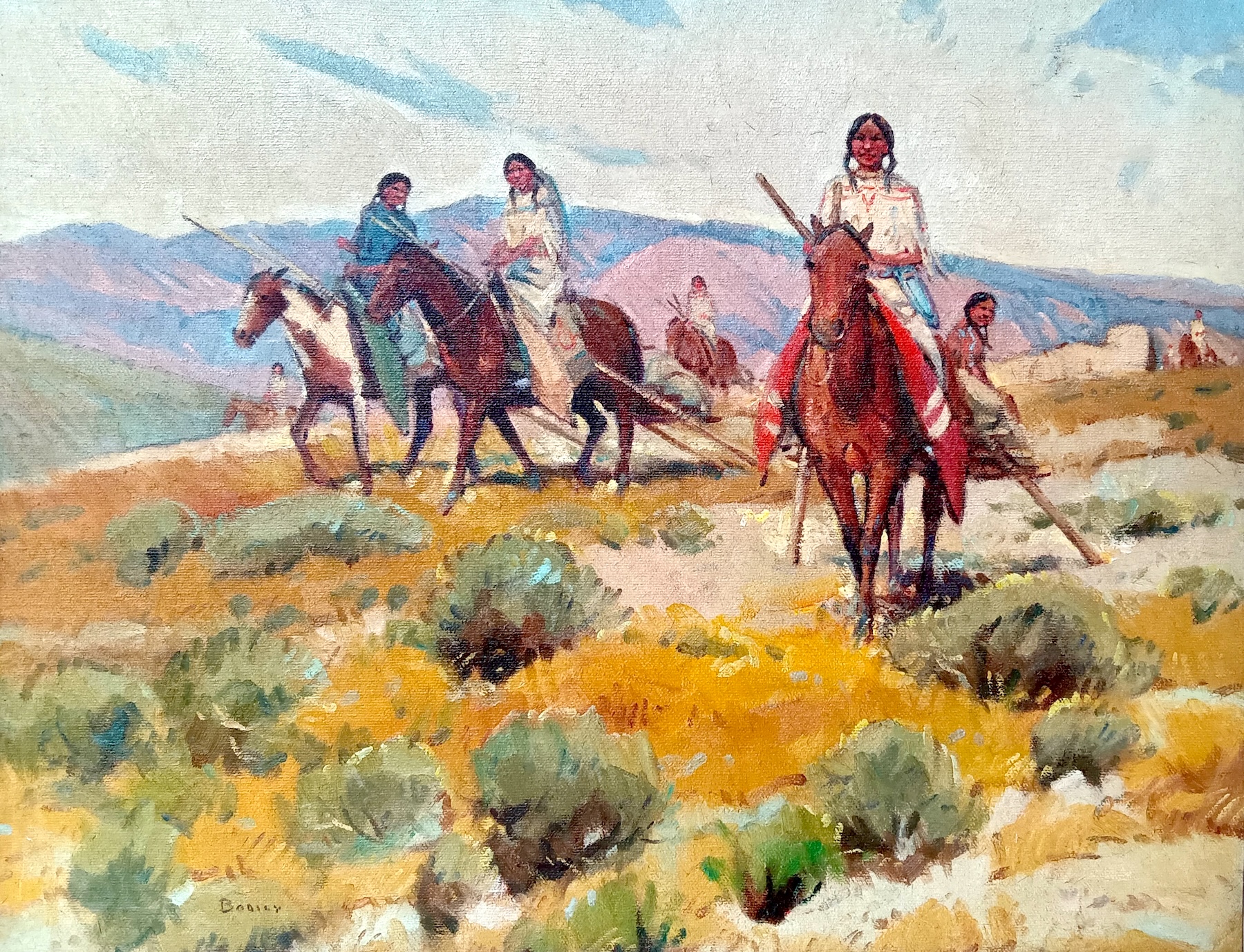
Traveling by Travois

This bright and vibrant Western scene depicts Native American women moving a mountain camp using a travois.


A travois was an A-frame structure consisting of a platform or netting mounted on two long poles. It was used extensively by Plains tribes and was dragged by hand, dogs, or, following the Spanish introduction of horses into North America in the 16th century, by actual horse power. The travois was able to travel over a variety of terrains, such as soft soil or snowy ground, that would have been difficult to navigate with wheels. 


The painting is by Sheryl Lamar Bodily (1936-2024). Born in Boise, Idaho, Bodily is renown for his detailed depictions of the West, and especially his respectful portrayals of Native American culture. He began oil painting at the age of 14 and studied commercial art for two years at Brigham Young University in Utah. His richly colored paintings are in numerous public and private collections throughout the world, including the Hockaday Museum of Art in Kalispell, Montana, and that of the late President Lyndon Johnson. Bodily has received numerous honors and awards, including 1986 Ellensburg Washington Rodeo Association Poster Award and the Goodey Indian Culture Award at the National Art Show.


All posted items are for sale at Next-to-New, but this can sell quickly!

3333-13500


Thursday, November 21, 2024

All Washed Up. . .

. . . is what you could be if you had this wonderful antique wash basin and pitcher set. Before the days of indoor plumbing, such sets allowed one to tidy up without having to visit the well or pump. The pitcher would be filled with water daily and a bit poured in the basin as needed for washing hands or face. The wealthy had sets of porcelain, or even silver or gold, often finely decorated, while the less affluent used simpler stoneware, earthenware, or pottery. This piece is earthenware, a low-fire ceramic that is more porous and softer than porcelain, but was also far more affordable. England has long been a producer of earthenware, dating back to the 1700s, but several advances allowed the rising middle class to adorn their homes with colorful and beautifully decorated wares. The first was the creation of transferware in the mid-1700s, in which a design could be printed on paper and then transferred to a porcelain or earthenware piece. Originally intended to copy the intricate blue and white designs of expensive imported Chinese porcelain, transferware was soon made in a variety of colors. The technique also allowed potteries to offer a wide variety of patterns. Using the lines of the transfer design as a guide, skilled decorators might fill in selected areas with additional colors before firing. Advances in printing technology later allowed multicolored transfers. Improved machinery and techniques introduced during the industrial revolution in the 19th century enabled English potteries to mass produce high quality and affordable wares, which were exported throughout the world.


The Chinoiserie pattern has Asian elements interpreted through English eyes. 


Underneath, the piece is stamped "Keeling & Co Ltd." Keeling was an English manufacturer of transfer-decorated earthenware, producing a variety of tableware, as well as decorative and utilitarian items. Founded in 1886, the company was in business until 1936. "Langham" appears to be the name of this pretty pattern.

It is also marked "Losol Ware." Losol Ware, introduced by Keeling in 1912, was the name given to a line of earthenware that used a glaze containing less than one per cent soluble lead, known as "low solubility glaze." Lead was originally used in ceramic glazes because it melted at a low temperature, gave the glaze a durable glass-like finish, and intensified certain colors. However, as companies and the public became more aware of the dangers of lead poisoning, manufacturers sought safer alternatives.


All posted items are for sale at Next-to-New, but things can sell quickly!

16822-7

Thursday, November 14, 2024

All the Way from Norway. . .

. . . is where this rather unique gent with an oddly engaging smile came from. He is a troll, not the Internet kind, but of the ancient and mythical variety. 


Trolls trace their origins back to Norse mythology. They were an ancient race who lived in the isolated forests and mountains. Some were giants, some had three heads, and others lived underground, but all were described as ugly, with a rough appearance, oversized nose, and a hairy cow-like tail. Generally they avoided people, but were protective of their woodlands and did not take kindly to trespassers, in some cases even eating unfortunate travelers. Slow-witted and often grouchy, trolls did possess some magical powers. They could place curses on humans who angered them and some were capable of shape-shifting. A troll might turn into a beautiful woman in an attempt to lure a hunter or farm boy into the woods. However, the troll could never disguise its tail and many a young man was saved when he noticed a tail twitching out from under the lovely lady's skirts. Trolls were night creatures and avoided sunlight, which would turn them into stone, and some of the craggy rocks along Norway's fjords or capping its mountains are claimed to be the remains of unwary trolls would failed to reach home by sunrise.


This troll was created by the Norwegian company, Ny Form, founded by Trygve Torgersen. Born in 1924, Trygve graduated from the Kunstakademiet (Art Academy) in 1945 with honors in sculpture. Following his marriage to Evelyn Signora Torgersen, the couple decided to create souvenir figurines and in 1957 started production of Norwegian nisse (elves) and trolls at their home in Oslo. However, most retailers found Trygve's creations too ugly and frightening. Taking advantage of a government program encouraging businesses to relocate to create more employment opportunities, in 1963 the couple moved to Tynset, joined by their daughter and son-in-law. Trygve designed a new line of figures and in 1964 Ny Form officially opened. The new creations, simultaneously ugly and endearing, were an immediate hit.  Ny Form trolls are now found in souvenir shops throughout Norway and the trolls are sought after by collectors from all over the world. Crafted from latex, each troll is handmade and painted, often topped with a wild wig of wool or reindeer fur. New models are introduced periodically and older ones retired. Evelyn and Trygve themselves retired in the 1970s, but their daughter and her husband continue to operate the company. This troll is a sizable 21 inches and is a model that was discontinued in 1995. 


Norwegian farmers believed that a small troll lived hidden on their farm; if the farmer angered the troll, such as being cruel to his animals or failing to take good care of the land, the troll could sour the cows' milk or wither the crops. To stay on the good side of the irascible troll, the farmer would leave out offerings of the troll's favorite food, porridge with butter. It is still a tradition in Norway to leave a bowl of porridge in the barn or on the porch at Christmas as a gift to the local troll. So with Christmas just around the corner, why not create a new tradition? Instead of an elf on the shelf, you can have a troll with a bowl.

All posted items are for sale at Next-to-New, but things can sell quickly!

16592-170