Thursday, August 25, 2022

Gleaming Guilloche

This week our trove has two treasures, stunning sterling necklaces from the famed Norwegian jewelry design firm of David-Andersen. Formed of graceful stylized leaves, one necklace is in brilliant blue enamel while the other is snowy white. The translucent enamel is applied over a machined background, a technique known as guilloche, which gives the enamel depth and makes it shimmer.


Gold- and silversmith David Andersen founded the company in 1876 in Oslo, 
Norway. His skill and artistry attracted many patrons and by 1892 he opened a second shop. David Andersen’s son, Arthur, took over the company upon his father's passing in 1901. In honor of his father, Arthur changed the name of the company to the hyphenated David-Andersen. Born in 1875, Arthur  graduated from the Norwegian National Academy of Craft and Art Industry in 1893. Under Anderson, the company began producing the enamel jewelry and wares for which it has become world famous. Although the company during its long history followed artistic trends, such as art nouveau, art deco, and modernism, it also took inspiration from traditional Scandinavian design, as well as from nature. David-Anderson jewelry is renown for its simple and refined forms, accented with vibrant enamel. The company is still family owned, now into the fourth generation.

Each necklace is marked both "Sterling" and with the assay mark "925 S." In addition to the company's "D-A" and stylized scales in a circle marks, there is a "W" mark for jewelry designer Willy Winnaess, who worked for David-Andersen in the 1950s.

 
All posted items are for sale at Next-to-New, but things can sell quickly.

12834-1150, 1151


Thursday, August 18, 2022

Like Father, Like Daughter

She

Next-to-New currently has two wonderful and whimsical works from outsider artists, father Mose Tolliver, and his daughter, Annie. Mose Tolliver, also known as Mose T., was a self-taught Alabama artist renown for his vibrant and imaginative folk paintings of people, religious subjects, and animals. He was born in Pike Road, Alabama, the child of sharecroppers. His exact birthday is unknown, but is thought to be between 1918 to 1925. In the 1960s, following an accident at an Alabama furniture factory that left him unable to stand or walk without crutches, Mose began to paint, using house paint on pieces of salvaged board or Masonite. A prolific artist, he gained recognition in the 1980s, following exhibitions at the Montgomery Museum of Fine Arts and the Corcoran Gallery in Washington, D.C. Mose died in 2006. His works are part of permanent collections throughout the world, including the Metropolitan Museum of Art in New York, the Smithsonian National Museum of American Art, the Centre Pompidou in Paris, and the Museum of Contemporary Art in Loss Angeles. 


The fantastical fish, boldly painted on board, is signed with Mose's typical signature, including the reversed "s."

Annie Tolliver (1950-2018) was inspired by her father. As a child, she loved to draw, but dropped out of school in the ninth grade to marry and start a family. Originally, Annie worked with her father, painting in his style and using his signature, but in 1990, encouraged by an art dealer, she began to create under her own name. Like her father, Annie often uses salvaged wood and house paint. She is known for her brightly colored imaginative paintings, often with humorous subjects and titles. Annie passed away on March 13, 2018. 


 All posted items are for sale at Next-to-New, but things can sell quickly!

3-6011, 3-6012

Thursday, August 11, 2022

Fantastic Fenton

This beautiful glass vase in glowing yellow is delicately painted with a chinoiserie landscape bordered by blossoms. It sits on a black glass base molded to look like carved Asian lacquer.  


This set is a scarce work of deco art glass created by the Fenton Art Glass Company in the 1930s. Founded in 1905 by brothers Frank and John Fenton in Martins Ferry, Ohio, the company originally decorated glassware purchased from other manufacturers. In 1907, the brothers opened the Fenton Art Glass factory in Williamstown, West Virginia, producing their own glass and introducing "iridescent ware," now known as "carnival glass." Inspired by the glass artistry of Tiffany and Steuben, Fenton produced a variety of colorful handmade glass objects, many enhanced with hand painting by the company's skilled artists. During the Depression era, Fenton added more practical items to its production, such as mixing bowls. The company ceased glass production in 2011, but its brightly-colored glassware, especially its earlier objects, are very popular with collectors.


The footed base is marked "Pat Pending."


 All posted items are for sale at Next-to-New, but things can sell quickly!

3-5946

Saturday, July 23, 2022

Astounding Squash Blossom

This stunning sterling silver and coral necklace was crafted by skilled Navajo silversmith, Fatoya Yazzie, renown for her contemporary take on traditional designs. 


This style of necklace is known as "squash blossom," named after the decorations dangling from the sides. Although the squash is an important crop for Southwestern tribes, the Navajo word for these designs means "bead that spreads out." The name "squash blossom" may be the result of a  mistranslation or misunderstanding, but this style of bead has been created by Navajo silversmiths since the late 1800s and the "squash blossom" name appears to have been around almost as long. Some think the squash blossom design is actually a representation of the crown-like tip of a pomegranate, a design element often found in early Spanish clothing and jewelry. The red coral was introduced to Native American silversmiths by European traders. 

The crescent-like pendant is known as a "naja." It originated in Moorish Spain as an amulet to ward off evil and the design is believed to have been brought to the Americas by Spanish conquistadors. 


The back of the naja is stamped "Sterling" and with the artisan's initials, "FY."


 All posted items are for sale at Next-to-New but things can sell quickly!

15878-3


Thursday, July 21, 2022

Hail! Fairy Queen. . .

adorn'd with flowers,
Attended by the smiling hours,
'Tis thine to dress the rosy bowers
In colours gay

"The Return of May," Felicia Dorothea Browne, 1808

This enchanting fairy, framed by delicate flowers, foliage, and flittering butterflies, is an example of elegant enameled glassware that became popular in the late 1800s. Against the soft rosy background of cranberry glass, an artist skillfully painted layers of white enamel, creating the effect of a carved cameo. In fact this style of enameled glass was produced to compete with the more costly cameo glass. Cameo glass was typically made of two fused layers of glass, a lighter (usually white) outer layer over a contrasting darker shell; the piece was then cut and etched to create a cameo-like design. 


The subtle shading and layering gives the images a three-dimensional effect. 


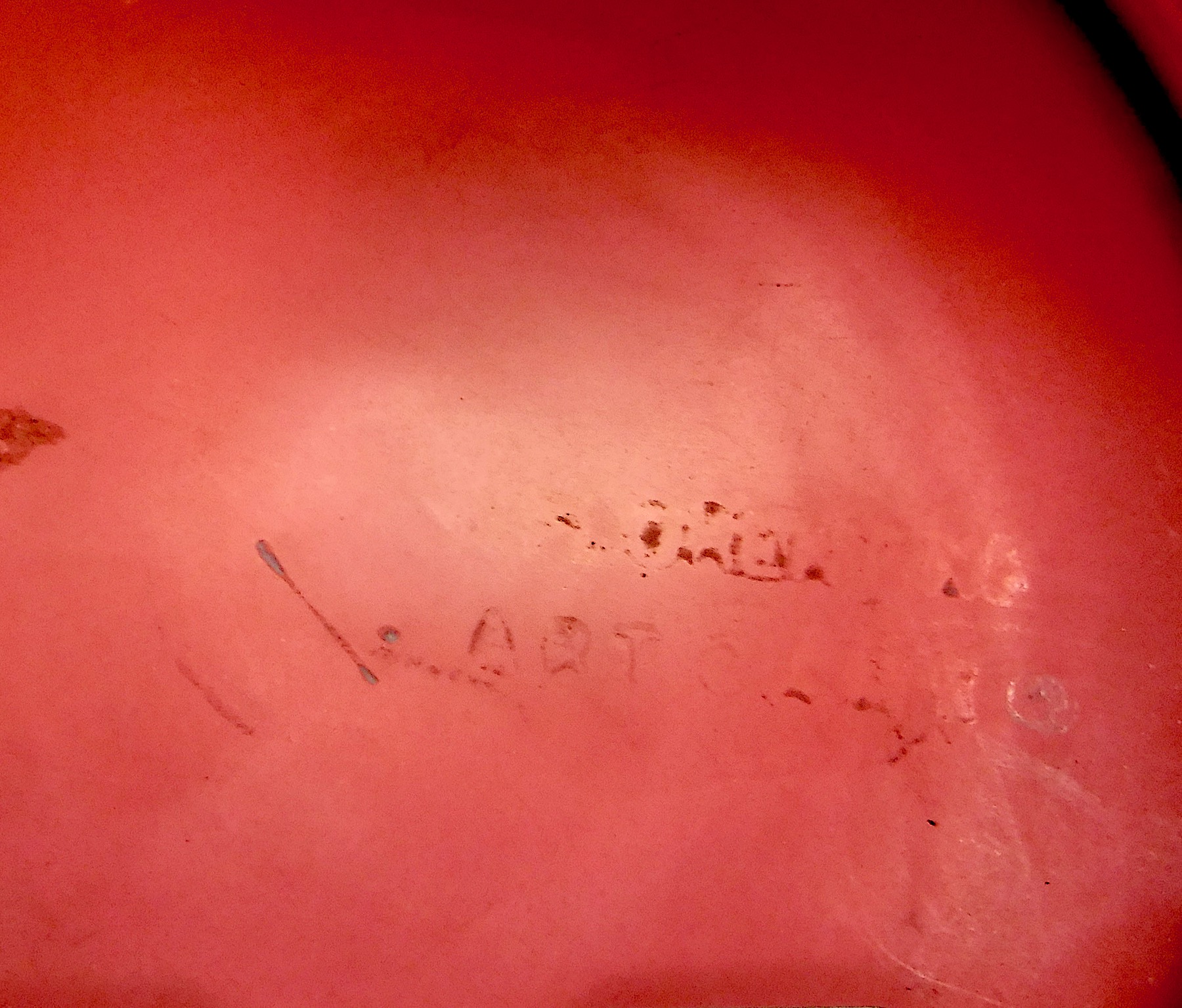
Underneath, the vase is faintly acid-etched "FLORENTINE ART CAMEO." This was one of the lines registered by Lazarus and Rosenfeld, a British company that specialized in high-end glassware, china, and pottery. In 1883, they established their glass refinery in Kamenické Šenov in Bohemia (now part of the Czech Republic).  The refinery ceased operations in 1934.


All posted items are for sale at Next-to-New, but things can sell quickly!

15885-1


Thursday, July 14, 2022

Mission Accomplished. . .

. . . is certainly what the proud future owner of this magnificent mission settee set would say when this outstanding oak furniture comes to grace his or her home. 

Dating from the 1910s, these beautifully crafted chairs and matching settee are done in American mission style. The American mission style, although referencing the missions of colonial California, actually evolved from the Arts and Crafts movement. Beginning in Britain in the 1890s, the movement  was a reaction against the over-ornamented and faux-historical style popular in Victorian England, advocating instead for balanced and unembellished designs crafted from natural materials. The American mission style is known for its solid and sturdy furniture, with simple lines and fine craftsmanship that underscores the natural beauty of the wood, typically oak. The unpretentious and understated style fits well with any decor from traditional to minimalist to mid-century modern. 

The set is attributed to the Michigan Chair Company, founded in 1890 in Grand Rapids, Michigan. The company came to produce chairs and accompanying occasional pieces in a wide variety of styles and woods. It first introduced a line of mission chairs as early as 1898, but by 1909 began creating more period revival and ornamented designs, such as Colonial, Elizabethan, Chippendale, and French. The company is still in business, although it has not produced furniture since 1970, instead offering custom solid hardwood steam bending.

All posted items are for sale at Next-to-New, but things can sell quickly!


15825-2


Thursday, June 23, 2022

Superb Pitcher

Summer is the time to enjoy a tall cold glass of iced tea or lemonade and this stunning sterling pitcher is just the the thing for serving your guests such refreshing libations.


Underneath, it is stamped "Sterling 925," but its hand-hammered design gives a clue to this shimmering silver pitcher's origin. . . .


The shoulder of the pitcher is adorned with in high relief with stylized flowers. Known as "Aztec rose," this pattern appears widely on vintage Mexican sterling, from flatware and serving pieces to jewelry. The roses are rendered in repoussé, meaning that they were shaped by hammering from the reverse side. The skilled silversmith then added further detail by engraving or stamping lines in the leaves and petals.


All posted items are for sale at Next-to-New, but things can sell quickly!

15735-242